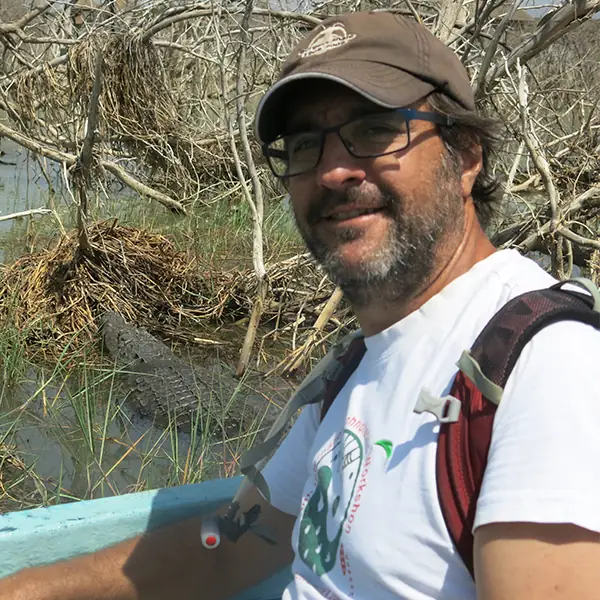
Dr. Luis A. Buatois (University of Saskatchewan, Canada)
Dr. Luis Buatois is a professor at the University of Saskatchewan (Canada) and a leading international authority in ichnology. His research focuses on trace fossils, paleoecology, and organism–substrate interactions through geological time.
Dr. Buatois is widely recognized for his contributions to the development and refinement of the ichnofacies model, a fundamental conceptual framework for interpreting depositional environments based on trace fossil assemblages. Throughout his career, he has investigated the evolution of marine and continental benthic ecosystems, as well as changes in community ecological structure across major geological transitions. His scientific output includes numerous influential papers and reference books in ichnology, and he has played a key role in integrating paleoecological data with sedimentology and stratigraphy. His research has significantly advanced our understanding of biological responses to environmental events and climate change on geological timescales.
This lecture reflects his commitment to critically revising and updating this paradigm, addressing its scope, limitations, and new perspectives in the study of past ecosystems.
Abstract
The ichnofacies model was proposed by Dolf Seilacher in the 1950s and 1960s in a series of papers initially published in German and later in English. This model established a relationship between the trace fossil record and environmental conditions along the depositional profile, triggering a surge of publications in ichnology applied to facies analysis. By the 1980s, the question arose whether the model had reached its maximum resolution. Studies conducted since then indicate that the answer is negative. The reasons for this include: (1) refinement in the characterization of the ichnofacies originally defined by Seilacher, including a better understanding of their environmental implications; (2) expansion of the model to the study of continental environments, particularly paleosols; (3) increased knowledge of substrate-controlled ichnofacies; and (4) the definition of additional ichnofacies for marginal marine environments, such as deltas and estuaries. These developments have occurred alongside more refined sedimentary facies analysis and an improved understanding of the role of evolutionary factors in organism–substrate interactions.