Conveners:
Dra. María Agustina Cócola (INGEOSUR-CONICET UNS; GEMS), Dra. María Celeste D’Annunzio (INGEOSUR-CONICET UNS; GEMS) y Dra. Verónica Emilia Bouhier (INGEOSUR-CONICET UNS; GEMS)
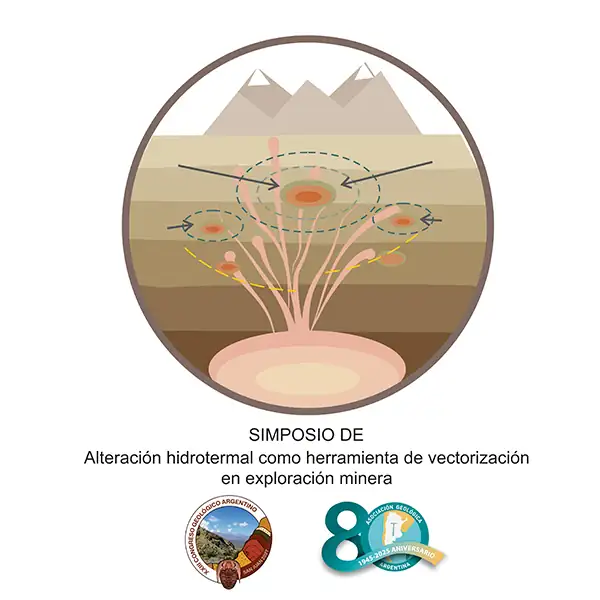
This symposium will focus on the role of hydrothermal alteration as a key tool in mineral exploration, addressing the processes that generate it in magmatic-hydrothermal systems and its application in resource identification. Spatial and temporal alteration patterns, their relationship with mineralizing processes, and their use in defining exploration targets will be discussed.
The symposium aims to integrate multiscale approaches, ranging from petrographic and mineralogical observations to geochemical analyses and predictive modeling, incorporating the study of alteration assemblages, zonation patterns, and vectors toward mineralization. Within this framework, it promotes the integration of field and laboratory studies with innovative tools to deepen understanding of hydrothermal alteration processes in magmatic-hydrothermal systems and optimize mineral exploration strategies.
Rationale: Hydrothermal alteration is one of the most robust tools for vectoring mineralized systems because it directly records the interaction between mineralizing fluids and host rocks. Its study allows the recognition of spatial and temporal patterns that reflect system evolution and their link to ore deposit formation.
In this context, the symposium seeks to create a space for discussion and knowledge integration aimed at incorporating innovative technologies and methodologies, with particular emphasis on understanding how alteration assemblages, mineralogical zonation, and geochemical signatures can be used to define vectors toward mineralization and improve the identification of exploration targets.
The relevance of this approach lies in the growing need to improve exploration efficiency, particularly in increasingly complex geological settings. Therefore, the symposium promotes a multiscale perspective that combines petrographic and mineralogical observations with advanced analytical tools and predictive modeling. It also seeks to integrate traditional methodologies with innovative approaches, including microanalysis, fluid inclusion studies, spectrometry, and artificial intelligence. In doing so, it aims to contribute to the development of more precise exploration strategies and a better understanding of hydrothermal alteration processes.